



TL;DR
- FiftyOne is excellent for exploring, visualizing, and debugging computer vision datasets, but it does not label data or manage a workforce.
- Teams usually go looking for a Voxel51 alternative when the bottleneck shifts from understanding data to producing and reviewing labels at scale.
- Taskmonk, Encord, Labelbox, Roboflow and CVAT are the closest head-to-head competitors for annotation plus curation.
- Roboflow leans toward training and deployment speed, while V7 and Label Studio serve specific modalities well.
- TaskMonk fits teams that need curation-adjacent QA and a managed, QC-heavy annotation workforce in one relationship instead of stitching two vendors together.
If you have ever opened FiftyOne on a Monday morning to find three thousand new frames waiting for review, you already know the feeling. The dataset looks clean in the app. The embeddings plot is beautiful. And then someone on the ML team asks who is actually going to label the new batch, tag the edge cases, and get it back before the next training run. FiftyOne does not answer that question. It was never built to.
That gap is why so many computer vision teams end up searching for a Voxel51 alternative in the middle of a project instead of the start. The tool that helped them understand their data suddenly cannot help them act on it. Annotation queues stall. Reviewers work off spreadsheets. The curation work that FiftyOne did so well starts to feel disconnected from everything that happens next.
This guide walks through what FiftyOne actually does well, why teams have to look past it, and which alternatives solve for annotation throughput, enterprise compliance, training speed, or a managed workforce instead of just visualization. We will also cover pricing, a comparison table, and a decision framework so you are not guessing.
What is Voxel51 (FiftyOne), and what is it good at?
Voxel51 built FiftyOne as an open-source tool for exploring and debugging visual datasets, and it has become the default way a lot of ML engineers look at their data before and after training. The core workflow is simple: load a dataset, visualize it, and use embeddings and similarity search to find the samples that matter.
FiftyOne's strongest feature is arguably its model evaluation layer. You can load ground truth and predictions side by side, sort by confidence or IOU, and jump straight to the frames where a model is failing. For teams doing computer vision work with any real scale, that kind of visibility into failure modes is hard to replicate with ad hoc scripts.
The platform also handles duplicate and near-duplicate detection well. FiftyOne Brain computes uniqueness and mistakenness scores that flag samples worth a second look, which matters when a dataset has grown past the point where anyone can eyeball it. And because it is Python-first, it slots into notebooks and existing ML pipelines without much friction for engineers who already live in that environment.
None of this makes FiftyOne an annotation tool. It integrates with labeling rather than shipping its own labeling workforce or advanced QA workflows, and that distinction drives most of the alternative-seeking behavior covered in the next section.
Why teams look for a Voxel51 alternative in 2026
The reasons teams start evaluating alternatives tend to cluster around a handful of real bottlenecks, not general dissatisfaction with the product.
The labeling gap: FiftyOne assumes you already have labels or are getting them from somewhere else. Once a project moves from understanding a dataset to labeling the next fifty thousand frames on a deadline, FiftyOne has nothing left to offer. Teams end up running two separate tools and manually syncing between them.
Python-only access : This shuts out non-technical reviewers. Domain experts, QA leads, and outsourced reviewers who are not comfortable in a Jupyter notebook cannot easily contribute inside FiftyOne. The open source app has a browser UI, but managing users, permissions, and review workflows at team scale requires the paid Teams tier.
Scale and rendering slow down: Several G2 reviewers note that rendering gets noticeably slower once a dataset crosses roughly fifty thousand samples, which is a real constraint for teams working with large video or geospatial collections.
No native training layer: FiftyOne helps you understand data and evaluate a model you already trained. It does not pretrain anything or generate labels automatically at scale, so teams chasing faster time-to-model look at platforms that fold in automation.
Opaque Enterprise pricing and workforce access: FiftyOne Teams pricing is not published and requires a sales conversation, and there is no built-in managed labeling workforce for teams that need one without hiring or vendor-managing it themselves.
What to look for in a Voxel51 alternative (evaluation criteria)
All this is based on actual queries that our team has replied on a call evaluating alternatives for a FiftyOne project:
Native annotation vs. bolted-on integration: Does the platform label data itself, or does it hand you off to CVAT or Labelbox the way FiftyOne does? Native annotation means one system of record for data, labels, and QA instead of two tools that drift out of sync.
Multimodal coverage: Images and video are table stakes. If your roadmap includes multimodal data such as audio paired with video, LiDAR, sensor fusion, or text alongside imagery, check whether the platform handles that natively or requires a separate tool per modality.
Scale under real load: Ask what happens at a million samples, not ten thousand. Rendering speed, search latency, and storage architecture all behave differently at production scale than in a demo.
QA depth: Look past “review workflow” as a checkbox and ask what the actual mechanism is. Consensus scoring, majority vote, and structured maker-checker review catch different error types than a single reviewer clicking approve.
Security and compliance posture: SOC 2, HIPAA, GDPR, and ISO 27001 matter differently depending on your industry, but regulated teams in healthcare, autonomous systems, or defense should treat this as a filter, not a feature.
Workforce model: Platform-only tools assume you bring your own labelers. Platform-plus-services vendors offer a managed workforce as an add-on. Fully managed workforce vendors handle sourcing, training, and QA end to end. These are three different buying decisions, and vendors get compared unfairly when this distinction gets flattened.
Pricing transparency: Open source cores are free to run yourself. Enterprise tiers are almost always quote-based. Know which one you are actually comparing before you get on a call.
The best Voxel51 alternatives in 2026
Encord
Encord pairs Encord Active (curation, natural language search) with Encord Annotate (labeling) in one platform, with SOC 2 and HIPAA certifications and strong video annotation via automatic object tracking and interpolation. G2 reviewers most frequently flag three things: navigation and access controls are hard for new users to find their way around, latency shows up when working with large cloud-hosted datasets, and the Python SDK lags behind what's available through the direct API. It's also fully proprietary with no self-hosted option, which is a hard stop for teams with data sovereignty requirements.
Labelbox
Labelbox's model-assisted labeling, consensus-based QA, and analytics that let teams monitor model predictions against ground truth are real advantages over stitching FiftyOne to a separate labeling tool. Everything happens in one place instead of two systems you sync by hand.
Where it comes up short next to FiftyOne is curation depth. Dataset exploration and embedding-based search are noticeably lighter than FiftyOne's native tooling. Reviewers also flag slower processing on heavy image workloads, limited offline capability, and task allocation and customization options that feel thinner than competitors offer.
CVAT
CVAT is free, self-hostable, and covers more annotation task types than any other open source tool on this list, boxes, polygons, tracking, pose, 3D point clouds, which is exactly what FiftyOne doesn't do natively.
The tradeoff is that CVAT only replaces half of what FiftyOne does. There's no embedding search, no duplicate detection, no model evaluation layer, so teams get the labels but lose the dataset understanding FiftyOne provided. It's also tied to Chrome as the primary supported browser, has a real learning curve for new users, and import performance degrades hard at scale. Teams have reported classification imports on datasets over 200,000 images taking more than 20 hours.
Label Studio
Label Studio's multimodal framework, text, image, audio, video, and time series in one system, covers ground FiftyOne doesn't touch at all, since FiftyOne is built for visual data specifically. Its XML-based templates mean you can build almost any labeling interface you need.
That flexibility comes at a cost. The learning curve is steeper than purpose-built tools, and video and 3D point cloud support are add-ons rather than native, so teams migrating off FiftyOne for video-heavy or LiDAR work will find CVAT a closer match than Label Studio.
V7
V7 is genuinely best in class for segmentation-heavy healthcare and life sciences work, with DICOM and whole-slide imaging support that neither FiftyOne nor most alternatives on this list handle natively.
Outside that lane, V7 is a narrower tool than FiftyOne in almost every direction. Curation is thin, there's no open source or self-hosted path at all, and the platform's strengths don't generalize to non-medical, non-video use cases the way FiftyOne's general-purpose visualization does.
Roboflow
Roboflow's path from raw images to a deployed YOLO model is faster than anything else on this list, and Roboflow Universe's library of public datasets is a genuine head start that FiftyOne doesn't offer.
The gap is dataset introspection. It's thinner than FiftyOne, Encord, or Labelbox, so teams that leaned on FiftyOne primarily for understanding data quality and distribution will feel that loss. Roboflow is also SaaS-first with limited on-premises support, which rules it out for teams with data residency requirements FiftyOne's self-hosted option could meet.
SuperAnnotate
SuperAnnotate's integrated managed workforce solves the exact problem FiftyOne can't: it actually labels data instead of just helping you understand it, with active learning built in to prioritize what gets labeled next.
The gap on the other side is curation. Model evaluation and dataset exploration are lighter than FiftyOne's native tooling, so teams often keep FiftyOne running upstream for that piece. Reviewers also note limited native support for text and audio relative to visual data, which matters for teams with multimodal roadmaps.
TaskMonk
TaskMonk gives ML teams what FiftyOne was never built to deliver: a QC system that adapts to each annotator's track record instead of applying one flat rule. DynamicPercentageRule routes a task to review based on an individual's rolling accuracy over the past month, so your best annotators clear work faster and your newest ones get watched closer, automatically. Golden Batches interleave pre-verified ground-truth tasks into the normal queue, blind to the annotator, and produce a Golden Accuracy score you can track per person, per project, over time.
Quality reporting goes deep by modality: IoU bands for image and video, pixel-level Jaccard Index for segmentation, WER/MER/WIP for audio benchmarked against published industry baselines. For LiDAR and DICOM work specifically, camera-LiDAR calibration sync, a Merged Point Cloud View, and native 2D multi-planar reconstruction with 3D volume rendering put TaskMonk in a modality tier FiftyOne and most annotation-only tools never touch. Deployment is flexible too: standard cloud hosting or on-premise, for teams whose data can't leave their own environment at all.
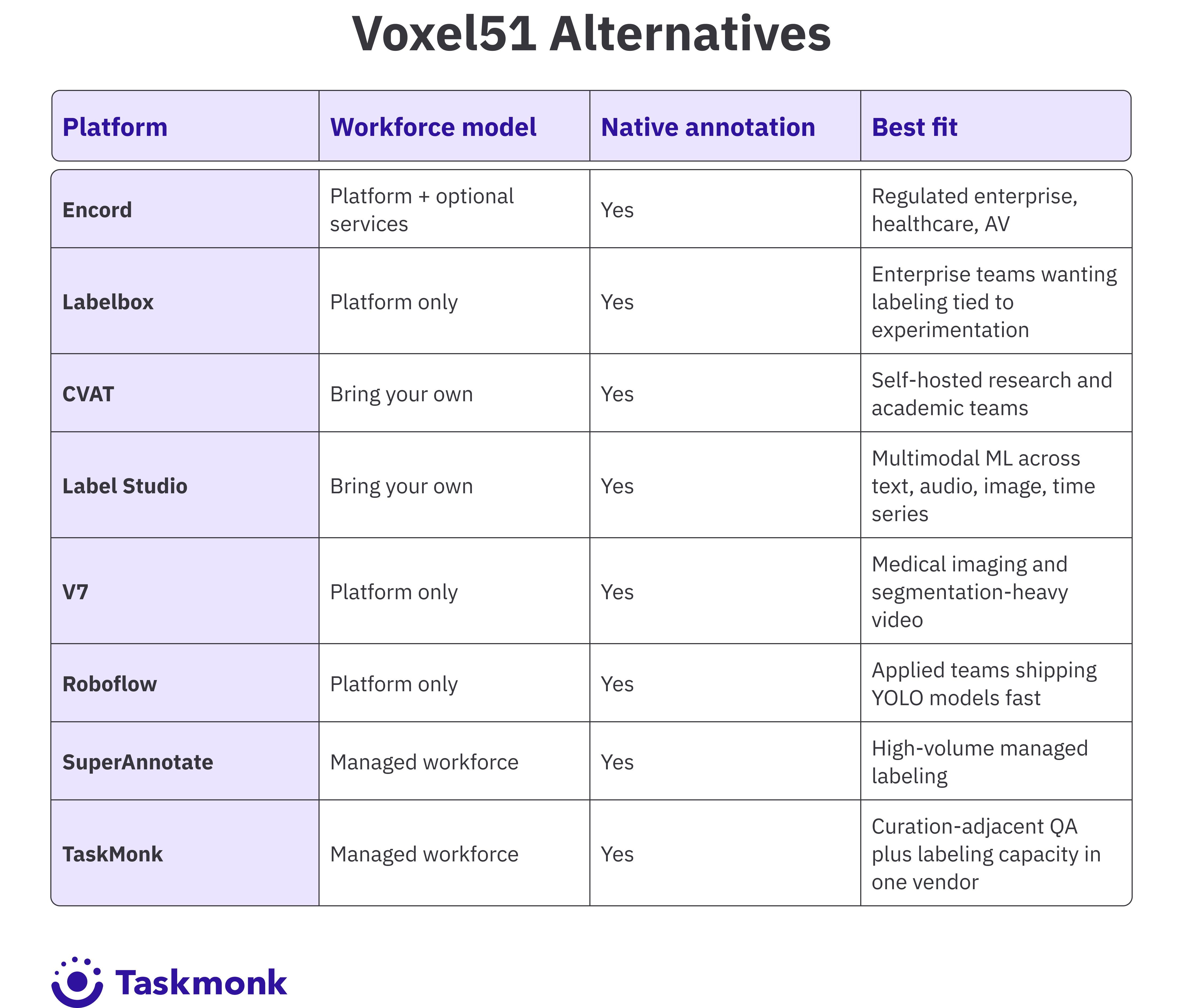
Voxel51 alternatives comparison table
How to choose the right alternative (decision framework)
Three questions resolve most of these decisions faster than a feature-by-feature bake-off.
What is actually broken right now?
If the problem is understanding a dataset you already have, you may not need to leave FiftyOne at all. If the problem is getting new data labeled and reviewed on a deadline, look at the annotation and workforce column of the comparison table, not the curation column.
Who is going to use this day to day?
Engineers comfortable in Python can work in almost anything. Reviewers, domain experts, and outsourced QA staff cannot, and that changes which platforms are actually usable by the people who will spend the most hours in them.
Do you need a managed workforce, or just software?
Buying software and buying labeling capacity are different purchases with different pricing models. A platform-only tool is a good deal if you already have annotators. It is a much worse deal if you are quietly expecting the vendor to also supply the people.
How to migrate from Voxel51 (FiftyOne)
Most teams do not fully replace FiftyOne. They keep it for exploration and evaluation and add an annotation layer underneath it, which makes migration lower-risk than it sounds.
Start by exporting your current dataset structure and labels in a format the new platform accepts. COCO and standard image formats cover most cases. Run a pilot batch, ideally the same 200 to 500 samples you already understand well from FiftyOne, so you can compare label quality against a known baseline instead of guessing.
Set up QA before volume, not after. Whatever consensus or review mechanism the new platform offers, configure it on the pilot batch so you catch calibration issues while the stakes are low. Once the pilot clears your quality bar, scale up the batch size and keep FiftyOne in the loop for spot-checking model performance against the newly labeled data. See TaskMonk's data collection and security practices for what to check before handing over a dataset to any new vendor.
The 2026 CV data landscape (context)
Computer vision data work has split into three layers that used to live in one tool: capture, curation, and annotation. FiftyOne owns curation. Purpose-built capture pipelines are emerging for physical AI and robotics use cases where the data does not exist yet and has to be collected first. Annotation and QA remain their own layer, increasingly separated from both, because labeling at scale is a workforce and process problem as much as a software one. Expect more teams to run best-of-breed tools per layer instead of expecting one platform to do all three well.
TaskMonk's take
Most "Voxel51 alternative" roundups treat this as a straight swap. That framing misses what's actually happening. FiftyOne is a genuinely good tool at what it does, and teams don't come looking for us because it let them down. They come looking because they hit the edge of what a curation and visualization tool can do, and the next problem, getting thousands of frames labeled to a standard a model can actually learn from, needs a different kind of platform.
That's the problem TaskMonk is built to solve, and we built it to run alongside FiftyOne rather than compete with it for the same job. Our QC doesn't treat every annotator or every task the same way. DynamicPercentageRule watches each annotator's accuracy trend and adjusts review intensity in real time, so quality control gets sharper exactly where it's needed. Golden Batches keep every annotator honest against verified ground truth, invisibly, so the accuracy number in your reports reflects real performance. For teams working in LiDAR or DICOM, that QC rigor extends into modalities most annotation platforms treat as an afterthought. And deployment isn't one-size-fits-all: cloud or on-premise, depending on where your data is allowed to live.
Here's the one gap we won't paper over: TaskMonk doesn't do embedding search or outlier detection. While these are in our 2026 roadmap, That's FiftyOne's job, and it's a good one. Running both isn't a compromise; it's the setup that costs you the least engineering time: no integration to build, no fragmented handoff to maintain, just FiftyOne deciding what needs labeling and TaskMonk delivering it labeled, reviewed, and production-ready.
If your bottleneck has shifted from understanding your data to getting it labeled on a deadline, talk to us about what a managed workforce and QC system built for your modality would actually look like.
Conclusion
Most teams searching for a Voxel51 alternative don't actually want to replace FiftyOne. What they need is help with a different problem: getting new data labeled and reviewed at volume, which FiftyOne was never built to do. Once that's clear, the shortlist gets a lot shorter.
Regulated enterprise teams should look hard at Encord. Teams that want training speed folded into the same pipeline should look at Roboflow. Teams that need volume and QC without building an internal labeling operation, particularly for LiDAR, DICOM, or video work at production quality, are the ones who end up talking to TaskMonk.
Keep FiftyOne for what it's good at: understanding your data. Pair it with a platform built for what comes next: getting that data labeled, reviewed, and production-ready on your timeline, not FiftyOne's. That pairing, not a swap, is what most of the teams on this list actually land on.
Frequently asked questions
Is there a free alternative to Voxel51?
Yes. CVAT and Label Studio both have free, self-hostable community editions with real annotation capability, and FiftyOne itself is open source and free to run. The tradeoff with any free option is that you take on hosting, scaling, and QA process design yourself instead of buying it as a managed service.
What is the best data curation tool for computer vision if I am not switching away from FiftyOne?
FiftyOne remains a strong default for curation specifically. Most teams that keep it do not replace the curation layer at all. They add an annotation and QA layer underneath it once labeling volume, not dataset understanding, becomes the bottleneck.
How much does Voxel51 pricing actually cost?
The open source FiftyOne library is free with no usage limits. FiftyOne Teams, the collaborative enterprise tier with permissions, roles, and cloud or on-prem deployment, is quote-based and requires talking to sales. There is a free trial available for Teams, but no public price list, so budget for a sales cycle if you are evaluating the paid tier.
Which Voxel51 alternative is best for video annotation specifically?
CVAT and V7 both handle frame-by-frame video labeling well, with V7 pulling ahead on medical and segmentation-heavy footage. For managed video annotation at volume with built-in QA, see TaskMonk's top video annotation tools for 2026 for a deeper comparison.
Can I use Voxel51 alongside an annotation vendor instead of replacing it?
Yes, and this is the more common setup than a full swap. Teams keep FiftyOne for exploration and model evaluation and add a labeling and QA layer underneath it, whether that is an annotation platform or a managed workforce. The two jobs are different enough that running both is rarely wasteful.
Does TaskMonk compete directly with Voxel51?
Not exactly. Voxel51 is a dataset curation and visualization tool. TaskMonk is a managed annotation and QC service. Teams that need both often run FiftyOne upstream for exploration and TaskMonk downstream for labeling and review, rather than treating it as a straight swap. TaskMonk shows up in “Voxel51 alternative” searches because it solves the labeling and workforce gap that FiftyOne leaves open, not because it replicates FiftyOne's visualization tooling.
What should I evaluate first if I am comparing multiple alternatives?
Start with the workforce question, because it eliminates half the list immediately. If you need labeling capacity and not just software, cross off every platform-only tool and focus your bake-off on the vendors that actually supply or manage annotators. See TaskMonk's data annotation services page for how that evaluation typically plays out for enterprise teams.


%20(1).png)
