iMerit Alternatives: 5 Vendors to Evaluate After the EXL Acquisition
TL;DR
- EXL is paying up to $310 million to acquire iMerit, with the deal closing in Q3 2026.
- Acquisitions change account teams, pricing, and roadmaps, even when nothing breaks on day one.
- Scale AI, Sama, SuperAnnotate, and Encord each solve a different annotation problem, not the same one.
- Every vendor here comes with a real, sourced limitation, not a vague “it depends.”
- TaskMonk's Maker-Checker QC and multimodal platform fit teams that want software and a workforce in one contract.
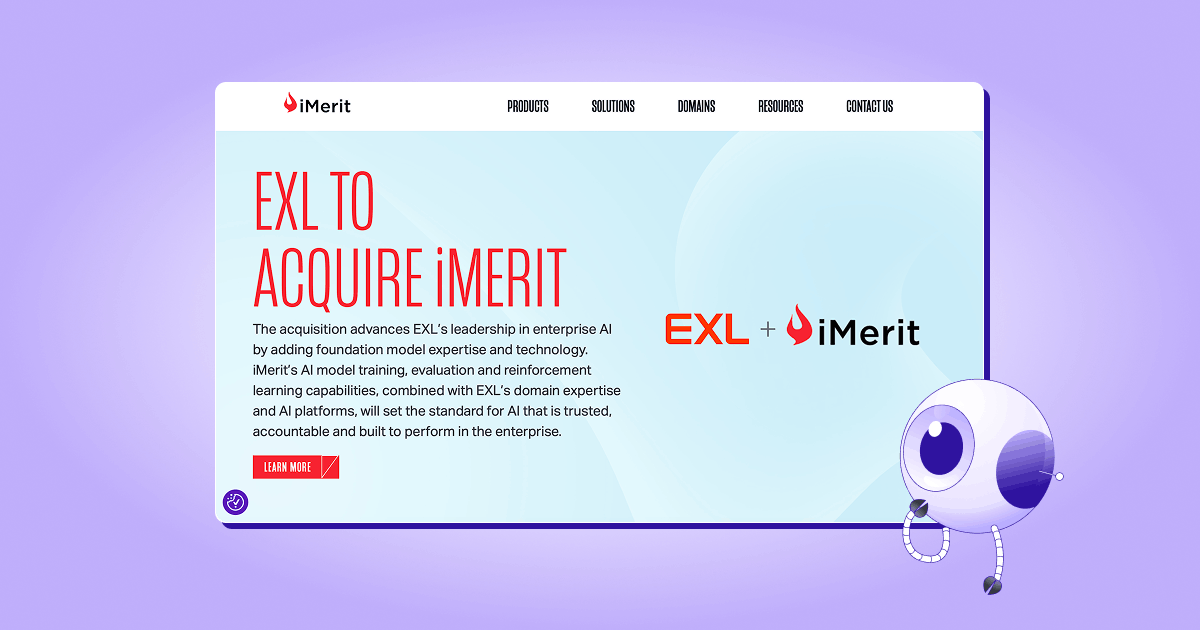
EXL agreed to pay up to $310 million for iMerit on June 24, 2026, with the deal expected to close in the third quarter. If you're already searching for iMerit alternatives, that's not a coincidence. It's a new owner for the vendor holding your annotation pipeline, your account team, and possibly your data processing agreements.
Acquisitions like this happen across the data annotation market with some regularity. Vendors get bought, rebranded, or folded into a parent company's broader AI consulting motion, and the buyer rarely changes much for existing clients in the first few weeks. But the account team that knows your taxonomy, your edge cases, and your QC history can change fast, and pricing structures tend to drift toward whatever model the acquiring company runs elsewhere.
This guide walks through what actually changes after an acquisition like this, what to check before you sign with a new vendor, and four annotation providers worth a serious look. We'll also cover where TaskMonk fits, including the real limits of its managed-workforce model, so you can weigh it the same way you'd weigh anyone else.
What the iMerit Acquisition Actually Means for Your Vendor Contract
EXL isn't buying iMerit as a standalone bolt-on. The deal runs through EXL's Clairvoyant AI subsidiary, and it folds in iMerit's Ango annotation platform along with its Scholars network of subject-matter experts used for RLHF and model evaluation work.
The structure of the deal matters more than the headline number. EXL is paying $170 million upfront, with up to $140 million more in earnouts tied to performance over the next two years. That earnout structure usually keeps the acquired company's leadership focused on hitting specific revenue and retention targets, not on rebuilding the product roadmap around what existing clients actually need next.
For teams currently running annotation programs through iMerit, the practical risk isn't that the lights go off. It's slower than that. Account teams reorganize, pricing gets standardized to match EXL's enterprise consulting rate card, and the product roadmap shifts toward whatever EXL's foundation-model partners are asking for. None of that shows up in week one. It shows up at renewal time, when the conversation looks different from the one you had last year.
Pro tip: Ask your account team directly whether your contract has a change-of-control clause and what it actually triggers. Most annotation contracts have one, but few buyers read it until they need it.
What to Check Before You Pick an iMerit Alternative
Switching annotation vendors costs more than the new contract. You're moving your taxonomy, your QC history, and your edge-case documentation to a team that has never seen your data. A few criteria separate a smooth switch from a six-month rebuild.
- Compliance certifications that match your industry: SOC 2, HIPAA, ISO 27001, GDPR
- Multimodal coverage, especially if your pipeline spans image, video, LiDAR, or DICOM alongside text
- QC methodology, not the marketing description of it. Ask for failure rates, not just “rigorous QA”
- Whether the vendor is a managed workforce, a self-serve platform, or a hybrid of both
- Domain depth in your specific vertical, not generic annotation experience across every industry
- Pricing transparency: published rate cards versus “contact sales” pricing that locks you into a long negotiation
Domain depth matters more than most RFPs account for. A vendor that has annotated millions of e-commerce product images doesn't automatically know how to label LiDAR point clouds for a picking robot, and the reverse is just as true. If robotics or autonomous systems sit on your roadmap, look for a vendor with documented robotics annotation experience, not just a feature list that says it supports the modality.
Pro tip: Run a paid pilot on the same 200-300 item sample with two finalists before you commit. Compare their QC rework rate on your edge cases, not their answer to “how do you ensure quality.”
5 iMerit Alternatives Worth Comparing
iMerit itself wasn't a pure managed-workforce shop. It ran the Ango annotation platform alongside its own workforce and the Scholars expert network, which is exactly the platform-plus-services combination EXL bought. Some of the vendors below are managed-workforce only. Others are pure software platforms that expect you to bring your own annotators or BPO partner. Whichever model you land on, weigh it against your industry-specific annotation needs before you compare feature lists line by line.
TaskMonk: Flexible Between Platform-Only and End-to-End
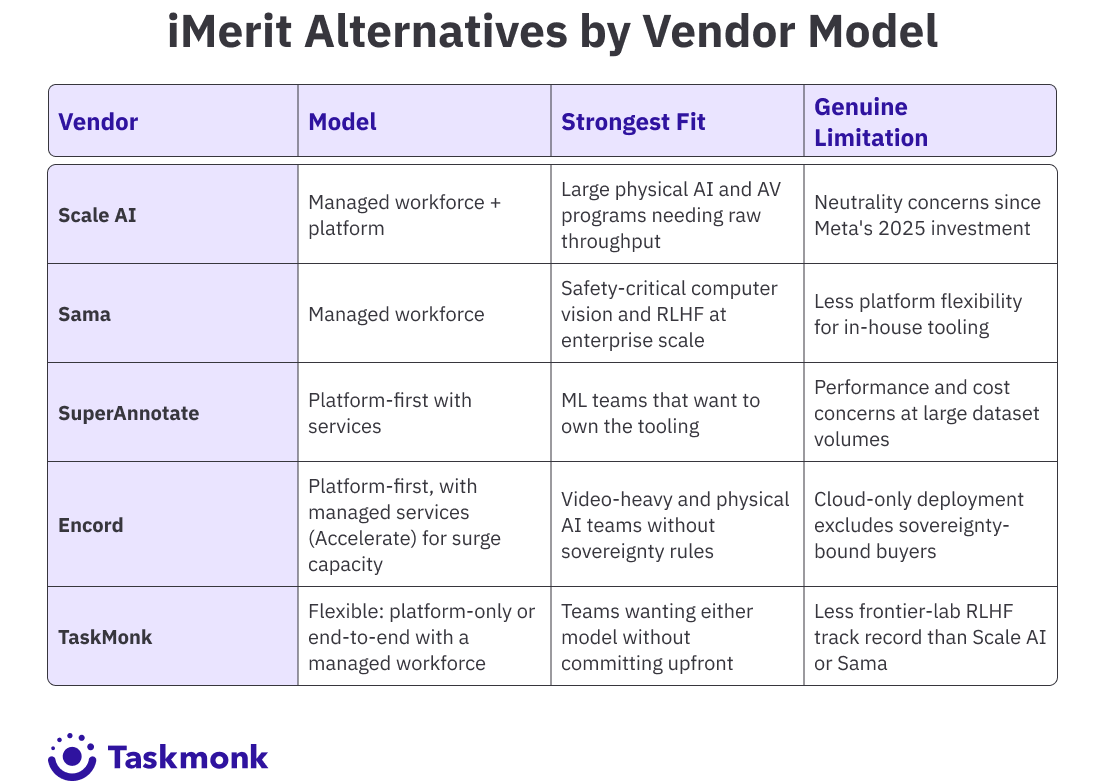
Teams leaving iMerit are usually solving for one of two problems. They need a workforce that already understands their domain, or they need a platform that doesn't lock them into one vendor's annotators. TaskMonk doesn't force a choice between the two. Teams can run the platform on its own with their own annotators, or use it end to end with TaskMonk's managed workforce.
Maker-Checker QC, plus two other review models. TaskMonk runs three QC methods: Maker-Checker, Maker-Editor, and Majority Vote, so teams can route ambiguous or high-stakes labels through a second reviewer without building a custom QA layer outside the platform. For e-commerce catalogs with millions of SKUs or robotics datasets where a mislabeled grasp point has real downstream cost, that built-in review path replaces what most teams currently stitch together with spreadsheets and Slack threads.
One platform across six modalities. TaskMonk handles text, image, video, audio, LiDAR, and DICOM in a single workspace, with affinity-based routing that matches annotators by language, domain, or industry expertise. Teams running both e-commerce attribute extraction and robotics LiDAR annotation, for instance, don't need to maintain two separate vendor relationships or retrain a second annotator pool on a different tool.
Model-assisted pre-labeling before human review. TaskMonk's AI pre-labels data ahead of time, so annotators spend their time on the labels that actually need a human judgment call instead of the obvious ones. For high-volume catalog or picking-robot programs where the same SKUs and scenes recur constantly, that cuts review time without lowering accuracy on the edge cases that matter.
TaskMonk has processed 480M+ tasks and logged 6M+ labeling hours across 10+ Fortune 500 clients, with a 4.6/5 rating on G2 and more than $10M saved for clients to date. Where it hasn't built the same track record as Scale AI or Sama is frontier-lab RLHF and foundation-model alignment work. Those vendors have years of direct delivery history with major AI labs on preference ranking and model evaluation. TaskMonk's depth is in enterprise verticals: e-commerce catalogs, robotics perception, and geospatial data, where domain-specific QC matters more than frontier-model alignment experience. Best fit: teams that want either a self-serve platform or a managed workforce, without committing to one model before they know how the program will scale.
If you're already comparing iMerit alternatives, the fastest way to know whether TaskMonk fits is to run a small batch of your own data through it. Book a demo with the TaskMonk team and ask them to walk through Maker-Checker QC on your actual edge cases, not a sample dataset built to look good.
Scale AI: Enterprise Scale, with a Neutrality Question Attached
Scale AI built its reputation on bounding boxes, segmentation, and LiDAR annotation for autonomous vehicle programs, then expanded into RLHF and LLM evaluation for major AI labs. It remains one of the largest pure-play annotation companies by revenue, and its synthetic edge-case generation is genuinely ahead of most competitors for physical AI programs that need rare-scenario coverage.
Meta's $14.3 billion investment in Scale in 2025 changed how some of the largest AI labs think about the vendor. Google, Microsoft, and OpenAI all pulled back from Scale afterward, reportedly over concerns that a direct competitor now had visibility into their training pipelines. If your roadmap competes with Meta in any way, that's worth asking about directly before you sign. Best fit: well-funded teams running large physical AI or AV programs that need throughput more than a long-term neutral partner.
Sama: Managed Workforce Built for Computer Vision and RLHF
Sama runs a full-time, trained workforce instead of a crowd-sourced pool, and that shows up in consistency on long-running computer vision and RLHF programs. It's a certified B Corporation whose impact-sourcing model has built full-time annotation careers for thousands of workers across East Africa and Asia, which is a real differentiator for clients with CSR commitments tied to vendor selection.
Sama is less a platform play and more a quality-first delivery partner, so teams that want to run their own in-house annotation tooling alongside an outsourced workforce will find less flexibility than a platform-first vendor offers. Best fit: enterprise computer vision teams where label accuracy on safety-critical perception is non-negotiable, and where workforce stability matters more than self-serve tooling.
SuperAnnotate: Platform-First, with Services Layered On Top
SuperAnnotate leans more software than service. Backed by investors including NVIDIA and Databricks Ventures, it gives ML teams a self-serve annotation interface with AI-assisted labeling, plus access to a managed network when teams want to outsource the labeling itself rather than just the tooling.
Slower performance on very large datasets is a recurring theme across user reviews, and smaller teams and individual users frequently flag the cost as steep relative to other annotation tools on the market. Best fit: ML teams that want to own the tooling and only occasionally lean on outsourced labeling capacity.
Encord: Multimodal Platform with Managed Services Layered On
Encord covers images, video, audio, text, DICOM, and LiDAR in one workspace, with native video tooling, object tracking, and temporal interpolation that reviewers consistently call out as the platform's strongest feature. Independent reviewers consistently rank it among the best in the category for teams labeling sequential or sensor data. It also runs Accelerate, a managed labeling service for teams that want surge capacity without hiring or training annotators themselves, so it isn't a platform-only play anymore.
Because Encord runs cloud-only, it isn't an option for organizations bound by data sovereignty rules or security policies that block third-party SaaS for sensitive workloads. New users also frequently struggle with the navigation, and reviewers report latency once datasets get large in the cloud. Best fit: video-heavy and physical AI teams without sovereignty constraints that want a platform-first setup with optional workforce capacity on demand.
Conclusion
The cost of getting a vendor switch wrong rarely shows up in the first month. It shows up months later, when a model's accuracy on edge cases quietly degrades because the new annotator pool never learned the nuances the old one had built up over two years.
Teams that switch well treat the move as a real evaluation, not a fire drill. They run a paid pilot with two or three vendors on the same dataset, compare QC failure rates instead of marketing claims, and ask pointed questions about what happens to their existing taxonomy and documentation during the handoff.
An acquisition like EXL's purchase of iMerit doesn't have to mean a rushed decision. It's a reason to run the evaluation you should have run before you signed your first contract, and to pick a vendor whose model actually matches what your data needs, not just whichever one shows up first in search results.
Frequently Asked Questions
How hard is it to migrate from iMerit to another annotation vendor?
It depends mostly on how well-documented your taxonomy and QC history already are. If your guidelines, edge-case decisions, and golden sets are written down and exportable, a new vendor can usually get a pilot batch running within two to three weeks. If that knowledge lives mostly in your old account manager's head, budget closer to six to eight weeks, since the new team has to reconstruct it through trial batches and rework cycles.
What happens to my data during a vendor transition like the EXL acquisition?
Your existing contract and data processing agreement still govern how iMerit, and now EXL, handle your data, regardless of the ownership change. That said, it's worth asking directly whether your data will be processed on the same infrastructure post-close, whether the same compliance certifications still apply, and whether any new subprocessors get added to the chain. Get the answers in writing, not just a verbal assurance from your account manager.
How does pricing compare across iMerit alternatives?
Managed-workforce providers like Sama and TaskMonk typically price per task or per labeling hour, with volume discounts as programs scale. Platform-first vendors like SuperAnnotate and Encord usually run subscription tiers based on data volume and seat count, plus separate costs if you tap their managed labeling network. Scale AI sits closer to enterprise consulting pricing, with custom contracts that reflect the size of the AI lab or program it's serving. None of the platform vendors publish full rate cards, so get a quote against your actual data volume before comparing.
How fast can a new annotation vendor onboard my team?
A focused pilot, meaning one use case with a sample dataset and clear guidelines, can usually be running within one to two weeks once you've handed over the SOP and a labeled gold-standard sample. Onboarding an entire program, with multiple modalities, QC workflows, and integrations into your existing data pipeline, realistically takes four to eight weeks. Anyone who promises a full production switch in under a week is either overselling or skipping a QC step you'll feel later.

.png)